


Job market research is the process of gathering, analyzing, and interpreting data about employment trends, workforce demands, industry growth, and career opportunities. It helps job seekers, employers, and policymakers understand the current labor environment and predict future changes. By examining wages, hiring patterns, required skills, and job availability, job market research provides valuable insights for better decision-making.
Understanding the Concept of Job Market Research
Job market research involves more than just scanning job boards. It studies economic indicators, demographic shifts, and business trends. It also evaluates skill shortages, emerging industries, and technological transformations that influence employment.
For individuals, this research supports career planning. For organizations, it informs recruitment strategies. Governments and educators also rely on job market research to design policies and training programs.
History of Job Market Research
The roots of job market research can be traced back to the early industrial era. Governments began collecting labor data in the late 19th century to understand employment patterns. By the 20th century, national labor statistics agencies were established to record wages, unemployment rates, and workforce demographics.
During the digital revolution, research expanded to include online job postings, real-time hiring trends, and data from recruitment platforms. Today, artificial intelligence and big data analytics are enhancing job market insights, making them more accurate and accessible.
The history of job market research dates back to the late 19th century, when governments started collecting data about employment to monitor industrial growth. During this time, labor bureaus were created to record unemployment rates, working conditions, and wage levels.
After World War II, job market research became even more important. Countries needed to rebuild their economies, and data about workforce availability and skill distribution played a central role. Governments relied on labor statistics to support veterans returning to civilian jobs and to guide industrial expansion.
In the 1980s and 1990s, globalization transformed job markets. Companies expanded across borders, creating demand for international workforce data. Job market research shifted from local statistics to global comparisons, with emphasis on trade, outsourcing, and multinational employment patterns.
In the 21st century, the rise of digital technology and the internet revolutionized job market research. Online platforms, recruitment databases, and big data analytics now allow real-time monitoring of hiring trends. Artificial intelligence and machine learning tools continue to refine how labor statistics are collected and interpreted, making predictions more reliable than ever before.
Importance of Job Market Research
For Job Seekers
- Identifies high-demand industries.
- Helps choose relevant skills to learn.
- Provides salary benchmarks.
- Informs relocation decisions.
For Employers
- Reveals competitive hiring strategies.
- Shows skill gaps in the workforce.
- Helps set fair compensation packages.
- Assists in talent retention planning.
For Policymakers
- Shapes labor laws and economic policies.
- Guides workforce training programs.
- Ensures sustainable economic growth.
Key Elements of Job Market Research
- Employment Trends – Tracks rising and declining industries.
- Wages and Salaries – Provides insights into compensation levels.
- Skill Demands – Identifies technical and soft skills in demand.
- Labor Supply – Analyzes workforce demographics and availability.
- Geographical Data – Highlights regional employment differences.
Current Statistics and Insights
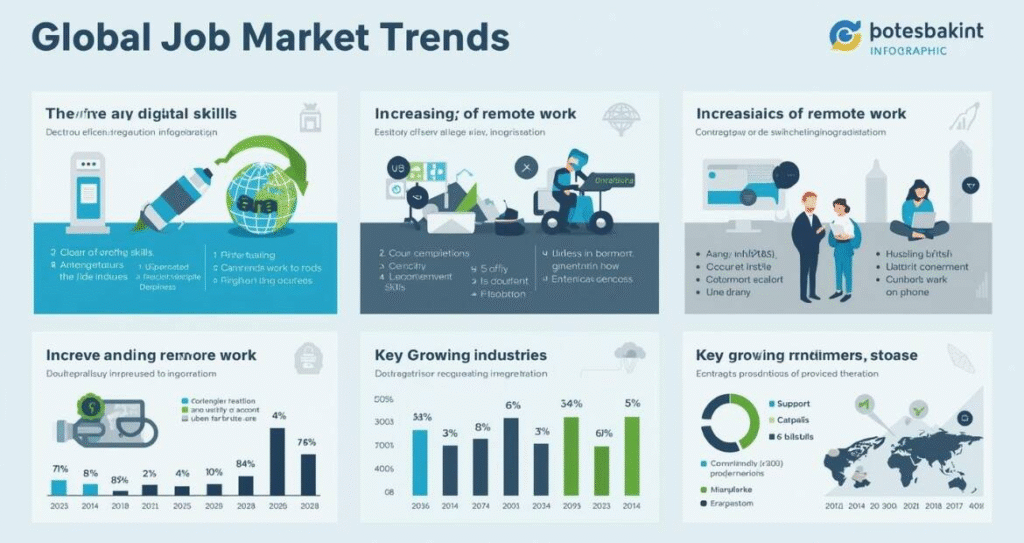
- According to recent surveys, digital skills are among the top requirements across industries.
- Remote work opportunities have grown by over 40% since 2020.
- The healthcare sector continues to expand, driven by aging populations.
- Technology and renewable energy fields are among the fastest-growing sectors.
Such statistics highlight why job market research is essential for understanding evolving career landscapes.
Modern job market research highlights several important workforce shifts:
- Technology Sector Growth: According to global reports, jobs in software development, cybersecurity, and artificial intelligence are projected to grow by 15–20% in the next decade.
- Healthcare Industry Expansion: Aging populations worldwide are driving healthcare jobs to increase by 13%, making nursing, medical technology, and elder care among the fastest-growing roles.
- Green Jobs: The renewable energy sector is expected to see a rise of over 20% as nations push for sustainability and carbon reduction.
- Remote Work Trends: Since 2020, remote work opportunities have increased by over 40%, reshaping how organizations approach hiring and productivity.
- Gig Economy: Freelance and contract work make up nearly 35% of the global workforce, showing a steady shift away from traditional employment.
Sample Job Market Growth Projection Table
| Industry | Projected Growth (Next 10 Years) | Key Drivers |
| Technology (AI, IT) | +15–20% | Automation, digitalization |
| Healthcare | +13% | Aging populations, demand |
| Renewable Energy | +20% | Climate change, green policy |
| E-commerce & Logistics | +12% | Online shopping boom |
| Gig Economy/Freelance | +10% | Flexible work demand |
These numbers highlight how job market research provides actionable insights for both individuals and organizations planning for the future.

Tools and Methods of Conducting Job Market Research
- Surveys and Reports: Conducted by labor bureaus and think tanks.
- Online Platforms: Job boards and networking sites provide real-time data.
- Industry Analysis: Reports from business associations.
- Academic Studies: Universities conduct workforce-related research.
- AI and Big Data: Advanced tools that predict job market trends.
Future Trends in Job Market Research
The future of job market research will be shaped by artificial intelligence, automation, and global shifts. Predictive analytics will become more accurate, offering real-time career insights. Sustainability and green jobs will emerge as crucial research areas.
Remote work and hybrid models will continue influencing job availability. Governments will invest more in data-driven policies to ensure that education aligns with workforce needs.
The future of job market research will be defined by technology, globalization, and workforce evolution.
- Artificial Intelligence and Automation
- AI will replace repetitive tasks, but it will also create new jobs in data science, robotics, and digital design.
- Research will focus on identifying transferable skills for workers transitioning to new industries.
- AI will replace repetitive tasks, but it will also create new jobs in data science, robotics, and digital design.
- Lifelong Learning and Upskilling
- Continuous learning will become a necessity.
- Job market research will increasingly link educational programs with industry needs, ensuring students learn skills employers demand.
- Continuous learning will become a necessity.
- Rise of the Gig Economy
- More people will work as freelancers, consultants, or part-time contractors.
- Research will track gig work’s impact on job security, income stability, and global labor laws.
- More people will work as freelancers, consultants, or part-time contractors.
- Sustainability and Green Jobs
- Renewable energy and environmental technology will be key areas of focus.
- Governments will push for “green reskilling” programs to transition workers from traditional industries into eco-friendly sectors.
- Renewable energy and environmental technology will be key areas of focus.
- Global Workforce Integration
- Remote work will allow companies to hire talent from anywhere.
- Job market research will focus on cross-border employment trends, wage gaps, and international competition.
- Remote work will allow companies to hire talent from anywhere.
By analyzing these future shifts, job market research ensures that economies, businesses, and individuals remain adaptable in a rapidly changing world.
Challenges in Job Market Research
- Rapid technological changes make data outdated quickly.
- Globalization creates complex employment patterns.
- Informal labor markets are difficult to measure.
- Predicting long-term trends remains uncertain.
Despite these challenges, continuous improvement in data collection ensures more reliable insights.
Practical Applications of Job Market Research
- Students can decide on courses aligned with future opportunities.
- Professionals can upgrade skills relevant to industry demand.
- Companies can build strategies for recruitment and retention.
- Governments can design training initiatives for citizens.
Frequently Asked Questions (FAQs)
1. What is job market research in simple terms?
It is the study of employment trends, skill demands, wages, and hiring patterns to understand the labor environment.
2. Why is job market research important?
It helps individuals make better career choices, employers improve recruitment, and policymakers design effective workforce strategies.
3. How do companies use job market research?
They use it to attract talent, set competitive salaries, and plan future hiring strategies.
4. Can job market research predict the future?
While not exact, advanced analytics can forecast employment trends and skill demands with reasonable accuracy.
5. What skills are currently in demand?
Digital literacy, data analysis, healthcare expertise, and renewable energy skills are among the most sought-after.
Conclusion
Job market research plays a vital role in shaping careers, businesses, and economies. It provides a clear picture of workforce dynamics and prepares individuals and organizations for future challenges. By understanding industry needs, salary expectations, and employment patterns, one can make informed decisions that lead to success.
The continuous evolution of technology and globalization makes job market research more important than ever. Staying updated ensures adaptability, competitiveness, and resilience in a changing world.

